
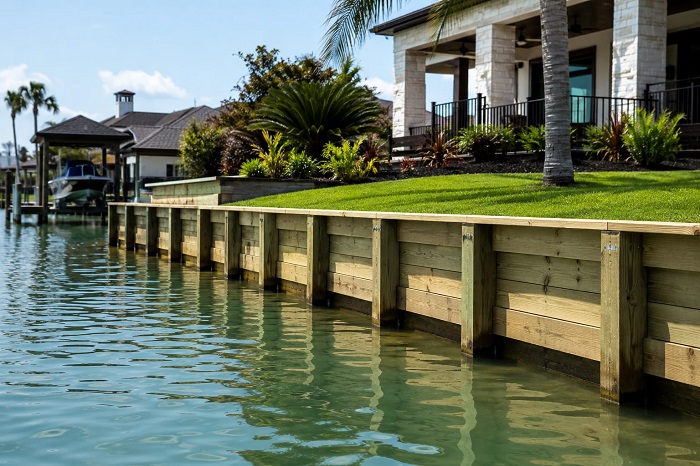
Wood remains one of the clearly listed bulkhead choices for Texas waterfront properties. The target page describes pressure-treated timber as a cost-smart material for lakes, canals, and bay-adjacent residential shorelines, with construction starting at $150 per linear foot for labor and materials. That starting point is useful, but it should be evaluated together with shoreline length, exposure, access, drainage, and the condition of the land behind the planned wall.
Owners who are comparing timber with vinyl, concrete, stone, or gabions can see the Texas pricing information before requesting a property-specific estimate. The listed numbers make it possible to compare the initial position of each material without assuming that every shoreline will require the same installation scope.
A wood bulkhead project should begin with the purpose of the wall. The structure is intended to retain the shoreline, limit soil loss, and support stability behind the wall. On a Texas lake or residential canal, the project may involve a new wall along an undeveloped edge, replacement of an older timber system, or repair of isolated areas where boards, caps, anchors, or backfill have deteriorated.
What the $150 starting price represents
The service page lists wood bulkheads from $150 per linear foot, including labor and materials. This is a starting cost rather than a universal quote. It establishes a baseline for early planning and helps a property owner compare timber with the other materials shown on the page.
The final amount depends on the measured shoreline run and the work required at the site. A clear shoreline where a new wall can be installed is not the same scope as a property with an existing leaning bulkhead, missing backfill, damaged cap sections, or limited access. The contractor must review the current conditions before the starting rate can be translated into a project estimate.
Where wood bulkheads fit in Texas
- Lake properties — The page identifies Texas lakes as a suitable setting for pressure-treated timber where the project goals align with a cost-smart shoreline retention system.
- Residential canals — Wood can be considered for canal-side properties where a vertical wall is needed to hold land behind the shoreline.
- Bay-adjacent residential sites — The material is also presented for residential shorelines near bays, subject to a review of exposure and site conditions.
- Repair and replacement projects — Existing timber bulkheads may need isolated board work, cap restoration, tie-back attention, reinforcement, or full replacement depending on movement and deterioration.
Questions to answer before selecting timber
Start with the visible behavior of the shoreline. Is soil washing out behind the wall? Are there areas where the face has moved? Does the top cap remain aligned? Are tie-rods or anchor components exposed? These observations help determine whether the project is a new installation, a repair, or a replacement.
Next, review the waterfront environment. The target page distinguishes calmer lake and canal applications from shorelines with greater wave exposure. A material decision should reflect that distinction. Timber may be attractive because of its starting price, but the contractor still needs to confirm that the site and the planned structure are a practical match.
Access is another budget question. A property in Katy or Sugar Land may have a very different path to the shoreline than a waterfront lot in Baytown. Gates, side-yard width, slopes, existing docks, landscaping, and obstacles near the water can affect the work plan. Photos should show both the shoreline and the route from the street or staging area to the project.
New construction versus wood bulkhead repair
The service page separates new wood construction from repair. New wood bulkheads start at $150 per linear foot, while bulkhead repair begins at $100 per linear foot. The lower repair starting point does not mean that every damaged timber wall can be repaired. The scope depends on whether the problem is localized and whether the remaining structure can still support a practical repair plan.
- Document isolated damage. Close photos of rotted boards, cap deterioration, gaps, leaning sections, and exposed hardware help show where the visible problem is located.
- Look for soil loss. Backfill disappearing behind the wall may indicate that the shoreline issue extends beyond one damaged board.
- Compare alignment. A continuous lean or bulge across multiple sections can suggest a broader structural problem than a single failed component.
- Review tie-backs and anchors. The page specifically lists tie-back and anchor needs as part of bulkhead repair planning.
- Ask for a defined recommendation. The contractor should explain whether the proposed scope is repair, reinforcement, or replacement and what visible conditions support that recommendation.
How timber compares with the other listed materials
Wood shares the lowest published new-construction starting price with stone and boulder bulkheads at $150 per linear foot. However, the two systems serve different visual and structural concepts. Timber forms a vertical shoreline wall, while stone and boulder work uses natural rock to dissipate wave energy and create a natural appearance.
Vinyl and gabion bulkheads both start at $200 per linear foot on the page. Vinyl is described as a low-maintenance option suited to Texas heat, humidity, and salt-air exposure. Gabions use rock fill in a flexible structure with natural drainage. Concrete starts at $300 per linear foot and is positioned for maximum durability and long-term performance.
This comparison shows why the starting price should not be the only filter. The correct question is not simply which material costs less. It is which listed system matches the shoreline, the desired appearance, the maintenance priority, and the practical installation conditions at the Texas property.
Preparing photos for a wood bulkhead estimate
For a preliminary estimate, the page requests a Texas property address, a description of the project, and photos of the full shoreline face, any leaning or cracking, and the top cap. For a timber project, include close views of boards, posts, cap elements, hardware, and areas where soil is visible through or behind the wall.
Wide-angle images should show the entire shoreline run from both ends when possible. Additional photos should show access from the property to the water. If the project is a replacement, identify the approximate length of the existing wall and the sections that appear most damaged. Accurate documentation helps the contractor distinguish a limited repair from a complete timber replacement.
Building a realistic wood bulkhead budget
A practical budget starts with the published $150-per-linear-foot figure and then adds the questions that the starting rate cannot answer: exact length, exposure, soil conditions, drainage, access, removal or repair work, and the final structural scope. Keeping those factors separate makes the estimate easier to understand.
For Texas owners in Houston, Pearland, Missouri City, and nearby communities, the best next step is to document the shoreline and request a preliminary review. The published price provides a useful benchmark, while the property-specific assessment determines whether pressure-treated wood is the right material and whether the project should proceed as new construction, repair, reinforcement, or replacement.